Planetary Cycles in Astrology
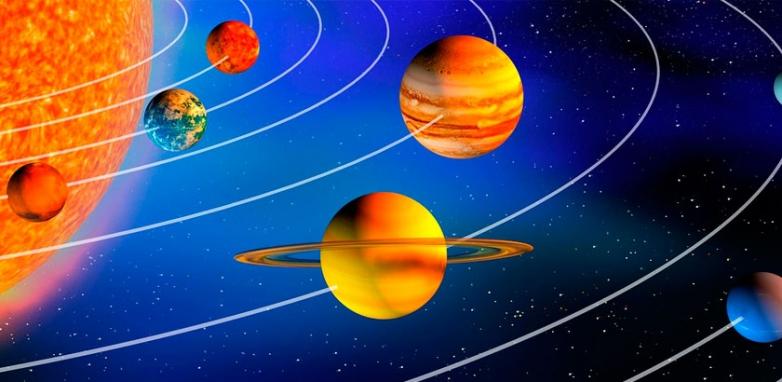
Planetary cycles are the periods each planet takes to complete its journey through the zodiac. In astrology, each of those cycles marks stages of development, change, and growth in a person's life, from the Moon's monthly cycle to Pluto's nearly 250-year orbit.
Astrology is the study of planetary movement through the zodiacal belt. The astrologer's focus is observing the resonance between each planet's path and the particular quality of energy available at a specific time and place.
When we look at a birth chart, we are looking at a specific moment in time, attempting to understand a person or event that began at that exact location and moment. Seeing a person through a celestial perspective, through a wider lens, is like observing our most direct connections to our origins.
The celestial sphere, however, is in constant motion. We cannot look only at the fixed pattern of the birth chart, which shows our entry into physical life. We also need to observe how the planets move through a person's life over time, how areas of emphasis and growth shift, and how we can be more fully ourselves in the present.
Personal Planets and Their Cycles
To understand planetary cycles, we first need to know how long each planet takes to travel through the zodiac.
The Moon moves fastest, completing all 12 signs in just 27.5 days. Pluto, at the other extreme, takes 248 years to complete the full circle.
The Moon's speed reveals much about its nature. We know the Moon governs emotional responses, habits, and the subconscious. Our emotional states can be fluid and changeable. There is a personal and intimate resonance with lunar energy in each of us, where we can observe how our feelings shift through life, the fleeting quality of our emotional responses, and a deeply rooted drive to meet our basic needs.
The monthly lunar cycle, from New Moon to Waning, to Full Moon and back to New, is one of the easiest cycles to observe and study, precisely because it moves so quickly. Working with lunar energy helps us become more conscious of our habits and instinctive reactions, just as the Sun's reflected light amplifies our response.
Mercury, Venus, and the Sun travel through the zodiac in approximately one year. The Sun's apparent movement defines our year with its 365-day passage, bringing the changing of seasons. The annual solstices and equinoxes are determined by the Sun's cyclical path. Our birthday each year marks the Sun's return to its natal position, infusing us with renewed vitality and a sense of mission for the year ahead.
Mercury governs the mind, the quality of thought, intellect, and communication. Venus, also with a roughly year-long cycle, teaches us about values and what we care about. Both planets orbit close to the Sun: Mercury never strays more than 28° from it, and Venus stays within 48°.
Mars has a longer cycle, taking about 22 months to travel through the zodiac. We have a roughly two-year window to work with our motivations and actions. When Mars returns to its natal position, we are compelled to initiate a new impulse that will be challenged and refined at predictable intervals as it moves through the signs.
Jupiter spends about one year in each sign, taking 12 years to complete the full zodiac. Every 12 years we experience a Jupiter return, the planet returning to the position it held at birth. Most of us experience this return at approximately 12, 24, 36, 48, 60, 72, and 84 years of age.
The Saturn return is one of the most significant cycles in astrology. It occurs for the first time around age 28 to 30, reflecting Saturn's 28 to 30-year orbit. Because Saturn governs the passage of time, gradual development, and the structures of reality, the key moments in its cycle tend to push us toward something tangible, or to confront our deeper fears and recognize them as allies on the path.
The Transpersonal Planets
Beyond Saturn lie the transpersonal planets, slower-moving bodies with the longest cycles. The influences of Uranus, Neptune, and Pluto shape our relationship with an entire generation, operating at the collective level.
Uranus is the planetary wildcard, with an 84-year orbit through the zodiac, or about seven years in each sign. At key moments in its cycle, around ages 21, 42, and 63, deep questions about individuality tend to surface, usually abruptly.
Neptune's orbit takes about 165 years, spending roughly 14 years in each sign. Neptune connects us not only to our spiritual longing, but also to the collective unconscious and to the people who share our deepest aspirations.
Pluto has an irregular orbit and takes 248 years to move through the entire zodiac. Pluto is also associated with the collective: that deep, penetrating realm where we continuously learn to release who we think we are.
How the Cycles Intersect: Aspects and Orbs
With this picture of the planets' varying orbital durations, we can begin to see how their cycles interpenetrate and create a complex web. The Moon, the Sun, and all other planets move around the horoscope and zodiac, forming aspects with each other and with the positions in the birth chart. Because the Moon travels so quickly, about 13° per day, it touches every point in the chart every 27.5 days.
Saturn forms significant aspects to the birth chart every seven years, often marking visible life redefinitions, particularly in how we relate to others.
A key concept for understanding the continuous movement of planetary cycles is aspect formation. As the faster of two planets approaches to form the exact aspect with the second, we say the aspect is applying. Once exact, as the faster planet moves away, the aspect enters separation.
For example: if Saturn is at 15° Pisces and the Sun is at 10° Cancer, the Sun is in applying trine to Saturn. If at the same time the Moon is at 12° Libra, it is separating from an aspect with the Sun. Though this may seem complex at first, it is a useful reminder that all celestial bodies are in constant motion and their relationship to each other shifts continuously. At every moment, new aspects form as others dissolve.
The question of orb also matters. An orb is the distance in longitude within which a planetary influence operates. An aspect involving the Sun in a birth chart may carry an orb of up to 8°. If Pluto is at 13° Scorpio and the Sun is anywhere between 5° and 21° Scorpio, the Sun is forming a conjunction with Pluto, applying from 5° to 13°, exact at 13°, and separating from 13° to 21°.
An Elegant Language Worth Learning
Astrology is a deep and elegant language. What is described here may feel layered on a first read, but the logic becomes clear with time and attention. Every planetary cycle, every aspect, every orb is part of a much larger whole, and you are part of that equation too.
Your birth chart is the starting point. Get your free birth chart on Astrolink to explore your personal planetary placements and see which cycles are shaping your life right now.