Root Chakra: what Muladhara is and what it says about you
There is a difference between knowing your life is fine and feeling that it has solid ground beneath it.
There are periods when everything feels more stable. Decisions come with more clarity, the body responds with more energy, and routine almost organizes itself without effort. At other times, even without an obvious reason, a feeling of instability arises, as if the rug could be pulled out from under you at any moment.
Within the chakra system, this experience has a name. It is Muladhara, also known as the root chakra.
What is the root chakra (Muladhara)?
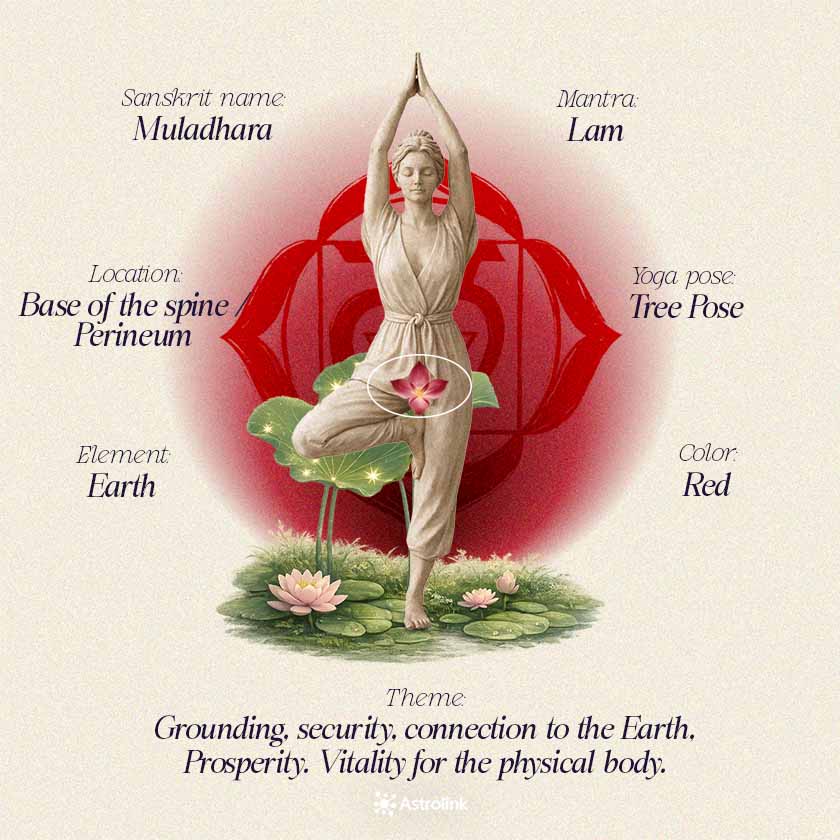
The root chakra, or Muladhara, is the first of the seven chakras in the traditional energy system. Located at the base of the spine, in the coccyx region, it represents the connection with the Earth, the feeling of safety and the support of material life: body, rest, food, shelter, routine and stability.
In Sanskrit, mula means root and adhara means base or support. The name already indicates its function: this is the chakra that supports the other energy centers.
Also known as the basic chakra, primordial chakra or simply chakra 1, Muladhara is the starting point of experience in the physical world. Before any emotional or spiritual development, there is an essential condition: feeling that there is ground, presence and support to live.
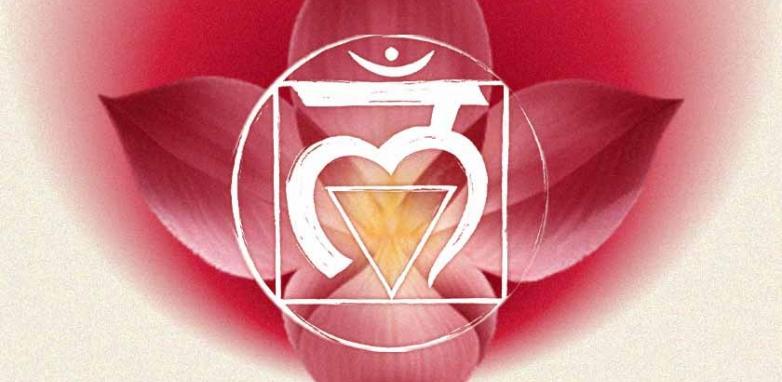
It is represented by the color red, associated with strength and instincts, and by the Earth element. Its symbol is a four-petaled lotus flower with a downward-pointing triangle, indicating the connection between body, matter and grounding.
Main information about the root chakra:
- Sanskrit name: Muladhara
- Meaning: root, base or support
- Position: base of the spine, coccyx region
- Element: Earth
- Color: red
- Mantra: Lam
- Central theme: safety, stability, physical body and survival
- Symbol: four-petaled lotus with a downward-pointing triangle
If you are not familiar with the full system yet, it is worth starting here: The 7 chakras: what they are, what they are for and how to balance them.
How does the root chakra influence safety, the body and routine?
This chakra does not only show up in moments of crisis. It is present all the time: in the way you react to the unexpected, in your relationship with money and stability, in the sensation that remains in the body when routine falls apart.
When Muladhara is stable, you tend to act with more objectivity. You can make practical decisions without freezing. You take care of concrete matters, such as finances, health and commitments, without turning them into a constant source of anxiety. There is a calm sense that it is possible to deal with what comes.
When it is out of balance, the opposite appears: difficulty getting organized, the feeling that the ground is always giving way, emotional reactivity toward situations that, at another moment, would not feel so heavy.
In energetic traditions, the root chakra is also associated with the physical body, especially the lower back, legs, feet, kidneys and adrenal glands. This association does not replace medical evaluation, but it helps observe how insecurity, tension and instability may also appear in the relationship with the body.
Blocked root chakra: what are the main signs?
When the root chakra is blocked or imbalanced, daily life starts demanding more than you feel you have to offer. The sense of foundation disappears.
Some signs that many traditions associate with imbalance in this chakra:
Signs of a blocked or weakened root chakra:
- Persistent feeling of insecurity or fear
- Low vitality or recurring fatigue
- Difficulty dealing with change
- Changes in sleep or appetite
- Feeling of instability or lack of belonging
Signs of an overactive root chakra:
- Intense need for control
- Excessive attachment to material security
- Excessive fear of losing stability
- Anger, jealousy or defensive reactions
- Difficulty relaxing
These signs are not diagnoses. They are an invitation to observe the current sense of support in your life.
What is a balanced root chakra like?
When Muladhara is in balance, the change is more subtle.
It is the feeling that life has a foundation, that it is possible to keep moving forward.
Some aspects that energetic traditions associate with a balanced root chakra:
- Basic needs met with stability: food, rest, shelter, safety
- Connection with your own body and physical vitality
- Organized routine without requiring constant effort
- Ability to take care of practical life without turning it into a source of anxiety
- Courage to face challenges without collapsing
- Feeling of grounding, as if there is solid ground beneath your feet
Balance, here, does not mean the absence of problems. It means having a foundation to move through them.
How to balance the root chakra in everyday life?
The first step is usually the simplest: noticing where foundation is missing.
Observing your own patterns, how you react to stress, to the unexpected, to the feeling of insecurity, is already a movement toward balance. From this awareness, some practices can support the process.
Reconnecting with the body and the physical environment helps. Walking barefoot on the earth, spending time in nature, having a routine with some predictability, taking care of food and sleep. These are simple practices that reinforce the concrete feeling of being present and supported.
But there is a difference between occasional practices and real work with the energy system. Understanding how the root chakra relates to the other centers, which patterns it carries and how to work with it in an integrated way requires going deeper.
This is the path the Astrolink Chakra Guide opens: a journey through the seven chakras in an integrated way, connecting body, emotion, behavior patterns and consciousness.