The 7 Chakras: what they are, meanings and how to balance them
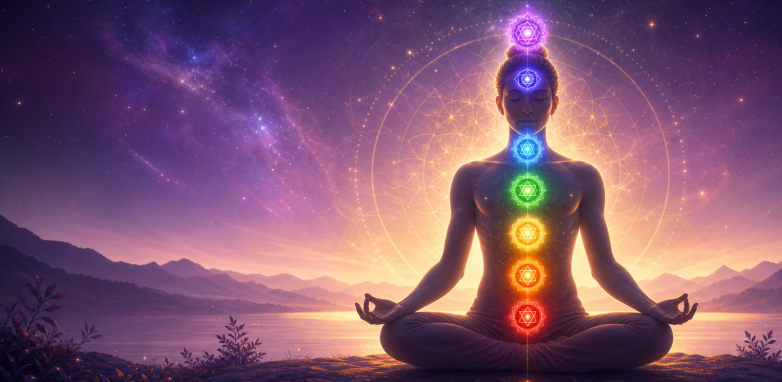
Have you ever woken up with the feeling that something was out of place?
It may be a strange pain in the body, emotional unease, lack of energy or even greater difficulty communicating clearly. You feel that something is not flowing well, but you cannot always explain exactly what it is.
Sometimes, this discomfort seems to go beyond everyday tiredness or stress. It is more subtle. As if some inner part of you were asking for attention.
In the Indian tradition, this perception can be understood through the chakras: energy centers associated with the body, emotions, mind and the way we relate to life.
In the West, this system became better known as the 7 chakras of the human body. Understanding how they work can help you better notice your internal signs and recognize where there may be excess, blockage or imbalance.
A note before we begin
Chakras are a system that originated in Indian Vedic philosophy and Ayurveda, an ancient tradition that is completely independent from Astrology. These bodies of knowledge can complement each other as tools for self-knowledge, but they have completely different foundations, cosmology and origins.
At Astrolink, preserving this distinction is part of our commitment to editorial seriousness. What you are about to read here is about chakras, not Astrology.
What are chakras?
According to Eastern tradition, chakras are subtle energy centers located along the central axis of the body, from the perineum to the top of the head. In the Vedic tradition, they represent points where consciousness, emotions and the physical body meet and influence one another. When a chakra is balanced, energy flows freely. When it is blocked, this flow is interrupted and the effects appear in behavior, emotions and, according to the tradition, the body.
The word "chakra" comes from Sanskrit and means wheel or disk, a reference to the spinning movement believed to characterize these energy centers.
The concept is more than 3,000 years old. It first appears in the Vedas, sacred Hindu texts, and was systematized in Tantra and Hatha Yoga over the centuries. It reached the West mainly from the 19th century onward, through translators and yoga practitioners who brought these teachings outside India.
How many chakras are there?
The best-known system in the West describes 7 main chakras, distributed along the spine. This is the system, originating in Tantra and popularized by modern yoga, that this guide covers.
It is worth knowing that there are other systems within the Indian tradition. Tibetan Tantra works with 5 chakras. Some lineages describe up to 114 energy points in the body. The number 7 became the most widely taught in the West because it was the focus of the translations and yoga practices that spread globally in the 20th century.
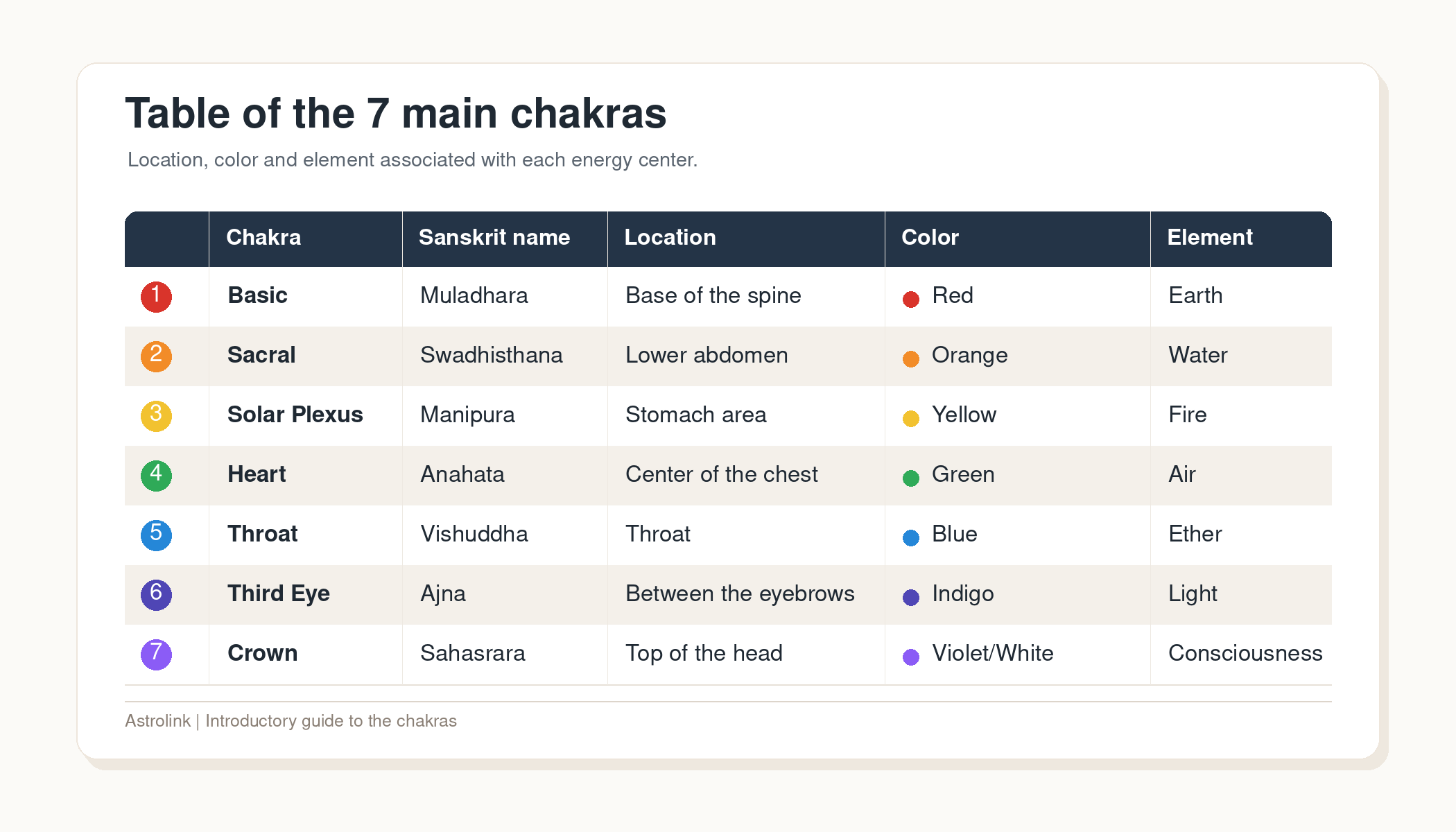
The 7 chakras of the human body
1. Root Chakra — Muladhara
Location: base of the spine
Color: red
Mantra: LAM
The root chakra, also called the basic chakra or Muladhara, is the foundation of the energy system. It governs everything related to survival, security and the sense of belonging to the physical world, such as money, housing, work and the body.
When it is balanced, you feel grounded, stable and able to deal with the practical challenges of life.
When it is blocked, symptoms may include constant anxiety, fear without a clear reason, recurring financial instability and difficulty feeling "at home" anywhere.
Go deeper into the meaning of the Root Chakra, what Muladhara is and what it says about you.
2. Sacral Chakra — Swadhisthana
Location: lower abdomen, below the navel
Color: orange
Mantra: VAM
The sacral chakra governs creativity, pleasure, sexuality and the ability to feel emotions, not only in the sense of identifying them, but of fully experiencing them.
When it is balanced, you move easily between work and pleasure, create without inner censorship and connect emotionally with people.
When it is blocked, it may show up as blocked creativity, difficulty feeling pleasure, repressed or explosive emotions and relationships marked by difficulty with intimacy.
Go deeper into the meaning of the Sacral Chakra and discover how Swadhisthana affects your emotions.
3. Solar Plexus Chakra — Manipura
Location: stomach area, above the navel
Color: yellow
Mantra: RAM
The solar plexus chakra is the center of personal power. It governs self-esteem, confidence, the ability to make decisions and to act in the world.
When it is balanced, you know your worth, act without needing constant validation and take responsibility for your choices.
When it is blocked, it may manifest as low self-esteem, excessive need for approval, difficulty saying no and the feeling that other people "run" your life.
Learn more about the Solar Plexus Chakra and discover the signs of imbalance in Manipura.
4. Heart Chakra — Anahata
Location: center of the chest
Color: green
Mantra: YAM
The heart chakra, also known as the cardiac chakra, is the point of balance between the lower chakras (matter, survival, identity) and the upper chakras (expression, intuition, spirituality). It governs love for yourself and others, as well as the ability to forgive.
When it is balanced, you relate with openness, heal emotional wounds more easily and are able to receive affection without resistance.
When it is blocked, there may be difficulty trusting, relationships marked by too much dependence or excessive distance, accumulated resentment and intense self-criticism.
Understand the Heart Chakra better and what it affects.
5. Throat Chakra — Vishuddha
Location: throat
Color: blue
Mantra: HAM
The throat chakra, also known as the laryngeal chakra, governs expression, the ability to say what you think, speak your truth and communicate authentically.
When it is balanced, you speak clearly and listen attentively. You neither swallow your words nor say more than you feel.
When it is blocked, you may feel difficulty expressing yourself, fear of judgment when speaking, a tendency to agree when you internally disagree and even recurring throat or voice problems.
To explore the Throat Chakra in depth, read the article on the topic.
6. Third Eye Chakra — Ajna
Location: between the eyebrows
Color: indigo
Mantra: OM
The frontal chakra, also called the third eye chakra, is the center of intuition, expanded perception and mental clarity. It allows you to see beyond the obvious, identify patterns, visualize connections and sense what is happening beneath the surface.
When it is balanced, you trust your perception, make decisions with greater clarity and have a healthy relationship with your dreams and insights.
When it is blocked, it may cause constant mental confusion, difficulty trusting your own intuition, rigid thinking and even frequent headaches.
To explore it in depth, read Third Eye Chakra: what Ajna is, signs and how to balance it.
7. Crown Chakra — Sahasrara
Location: top of the head
Color: violet or white
Mantra: silence after OM
The crown chakra is the point of connection with the deepest dimensions of existence. It integrates knowledge, experience and consciousness, generating a sense of belonging to something beyond oneself.
When it is balanced, you experience moments of deep peace, have clarity about what gives meaning to your life and feel connected, even in solitude.
When it is blocked, you may feel existential emptiness, disconnection, lack of purpose, spiritual rigidity or, at the opposite extreme, dissociation from reality.
To explore it in depth, read Crown Chakra: what Sahasrara is and how to balance it.
How do you know if your chakras are blocked?
A chakra blockage is not a permanent state: it is a pattern that tends to repeat itself until it is recognized.
The most common signs of imbalance in the chakra system include emotions that seem disproportionate to the situation, relational difficulties that repeat with different people, recurring physical sensations without a clear medical cause and thoughts that revolve around the same fear or limitation.
To learn more about blocked chakras, read the article: Blocked chakra: symptoms, causes and how to identify it.
But pay attention: an article does not replace a real process of self-knowledge. The signs listed here are entry points and serve as indicators that it may be worth looking more closely at a certain area of your life.
The precise diagnosis of each chakra, with its specific practices, its relationship with emotional history and the exercises for rebalancing, is what the Astrolink Chakra Guide was developed to provide.
Where to start with the chakras?
You have just had an overview of the 7 energy centers, their functions and the first signs of imbalance. This is the starting point.
The next step, for those who want to go beyond the conceptual, is to learn how to work with each chakra in a practical way: breathing techniques, mantras, guided meditations, the emotional patterns associated with each center and what to do when a blockage persists.
Astrolink’s Chakra Guide features balancing protocols for each chakra, breathing exercises, and meditations to help you work with your energy system.