Third Eye Chakra: What Ajna Is, Signs and How to Balance It
The greatest challenge is not always what happens. Often, it is the way we interpret what happens.
The same situation can seem clear one day and completely confusing on another. The same problem can feel insurmountable or simply like one more obstacle, depending on the state of the mind. This ability to perceive, interpret and understand reality is what distinguishes a mind trapped only in what is right in front of it from a mind capable of seeing beyond the surface.
Within the chakra system, this function has a specific center. It is Ajna, also called the third eye chakra.
What is the third eye chakra (Ajna)?
The third eye chakra is the sixth of the seven chakras in the traditional energy system. Located between the eyebrows, it is associated with perception, intuition, mental clarity and the ability to understand experiences in depth.
In Sanskrit, Ajna is often associated with the idea of command, perception or inner guidance. The name points to an essential function: integrating, organizing and giving meaning to the information that comes from the inner and outer worlds.
Also called the third eye chakra, Ajna is often described as a symbolic portal of intuition. Not in the sense of seeing the future, but of perceiving beyond appearances: recognizing patterns, understanding situations more deeply and making decisions with greater discernment. If the throat chakra gives form to expression, the third eye chakra organizes perception before words, choices and actions.
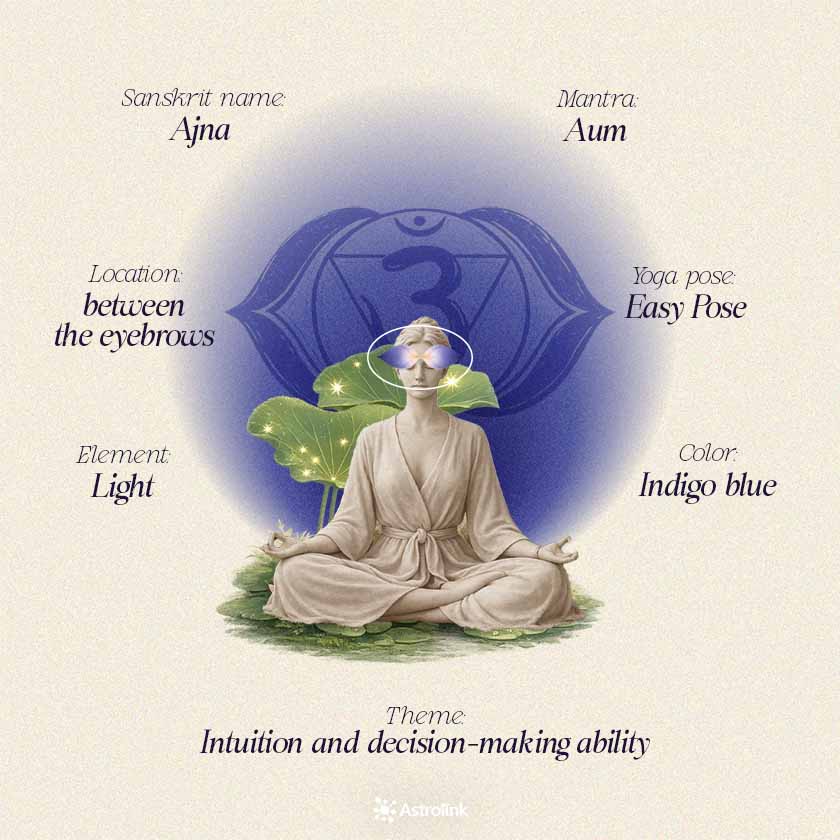
It is associated with the color indigo blue, connected to depth and consciousness, and symbolically with the element Light. In the energetic tradition, light is not something that can be touched, but something that reveals: it illuminates, differentiates and allows us to see clearly. In the context of this chakra, this translates into discernment, meaning the ability to distinguish what is real from what is projection.
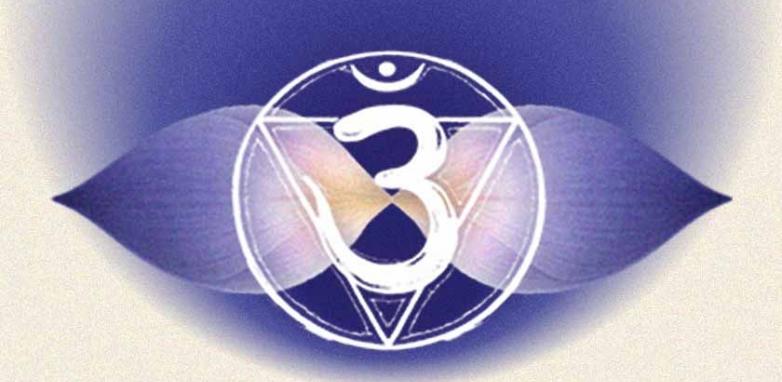
Its symbol is a lotus flower with two petals and an inverted triangle at the center, representing introspection and focus on inner perception.
Main information about the third eye chakra:
- Sanskrit name: Ajna
- Meaning: command, perception or inner guidance
- Position: between the eyebrows
- Element: Light
- Color: indigo blue
- Mantra: Om
- Central theme: intuition, perception, discernment and mental clarity
- Symbol: two-petaled lotus with an inverted triangle
If you are not familiar with the full chakra system yet, it is worth starting here: The 7 chakras: what they are, what they are for and how to balance them.
How does the third eye chakra influence intuition, mental clarity and decisions?
This chakra is present in concrete situations of everyday life. It appears in the ease or difficulty of concentrating, in the ability to make decisions without depending on validation from others, and in the way you interpret a situation before reacting to it.
When Ajna is balanced, the mind works with greater clarity. You observe better before drawing conclusions, understand situations more deeply and act with more confidence. Intuition appears as a real resource, not as something vague or inexplicable.
When it is out of balance, that clarity is lost. The mind may become confused, scattered or excessively imaginative, creating interpretations that do not correspond to reality. Difficulty concentrating, indecision, dependence on other people’s opinions to make decisions or a feeling of being lost without clear direction may arise.
In energetic traditions, the third eye chakra is associated with the pineal gland and, in some interpretations, also with the pituitary gland. These associations are symbolic and do not replace medical evaluation, but they reinforce the central idea of Ajna: a point of integration, perception and internal regulation, where information is organized and transformed into direction.
In some energetic readings, this chakra is also related to the eyes, forehead, paranasal sinuses and face. When recurring tension or discomfort appears in this area, some traditions suggest also observing mental clarity, excessive thoughts and the ability to interpret situations. Not as a diagnosis, but as an invitation to perception.
Blocked third eye chakra: what are the main signs?
When the third eye chakra is blocked or imbalanced, the relationship with one’s own perception becomes compromised. The mind loses clarity or begins to create distortions of what is real.
Signs of a weakened or blocked third eye chakra:
- Difficulty with focus, concentration and mental organization
- Feeling of confusion or lack of clarity in decisions
- Excessive dependence on other people’s opinions to make decisions
- Difficulty trusting one’s own perception
- Feeling lost or without direction
- Excessive doubts or difficulty seeing possibilities
- Frequent headaches or discomfort in the forehead and nasal region
Signs of an overactive third eye chakra:
- Mind excessively scattered or dominated by worries
- Racing or repetitive thoughts that make clear perception difficult
- Tendency to create interpretations or fantasies disconnected from reality
- Excessive analysis, rationalization or distrust
- Difficulty resting the mind or connecting with the body
- Anxiety in the face of uncertainty or a feeling of panic
These signs are not diagnoses. They are an invitation to observe how your mental clarity, intuition and ability to interpret reality are right now.
What is a balanced third eye chakra like?
When Ajna is in balance, the mind gains more space to observe before reacting. There is more clarity. More presence.
Some aspects that energetic traditions associate with a balanced third eye chakra:
- More developed perception and intuition
- Greater mental clarity for reasoning, learning and reflection
- Imagination and creativity balanced with discernment
- Ability to understand situations in depth
- Confidence to make decisions more autonomously
- Less dependence on external validation
- Greater ability to observe internal and external patterns
- Discernment to differentiate intuition from fear, desire or projection
- More frequent insights about yourself and life experiences
Balance, here, does not mean always having the right answers. It means having enough clarity to ask the right questions.
How to balance the third eye chakra in everyday life?
The first step is usually to reduce excess mental noise. A mind overloaded with thoughts cannot perceive clearly. For this reason, practices that favor inner silence play a central role here.
Meditation is one of the practices most associated with balancing this chakra. It does not need to be long or formal: a few minutes of observing the mind, without trying to control what appears, already contributes to clearer perception. Moments of contemplation, contact with nature or simple pauses throughout the day serve a similar purpose.
But there is a difference between occasional practices and integrated work with the energy system. Understanding how the third eye chakra relates to the other centers, which perception patterns it carries and how to work with it in depth requires going beyond the surface.
This is the path the Astrolink Chakra Guide opens: a journey through the seven chakras in an integrated way, connecting body, emotion, behavior patterns and consciousness.