Solar and Lunar Eclipses: Understanding the Phenomenon, Types, and Meanings
Published in: 06/05/2025 at 04:01 PM
Last update: 07/13/2026 at 09:02 AM
1. What are the 4 types of eclipses?
2. Which solar eclipse is considered the rarest?
3. Which eclipse made day turn into night?
4. How many eclipses occur per year?
5. Is it true there will be eclipses in 2026?
6. What is the difference between a solar and a lunar eclipse?
Solar and lunar eclipses are astronomical phenomena that occur when the Sun, Moon, and Earth align in a specific way, resulting in periods of total or partial shadow. Beyond the visual impact, eclipses symbolize moments of transition, closure, and the redefinition of cycles. There are different types of eclipses, each with its own characteristics, specific duration, and distinct effects both in the sky and in astrological interpretation.
Eclipses are astronomical events that occur when one celestial body blocks the light of another, either totally or partially. A solar eclipse happens during the New Moon, when the Moon is positioned between the Earth and the Sun. A lunar eclipse, on the other hand, occurs during the Full Moon, when the Earth casts its shadow over the Moon. These phenomena are divided into different types, such as total, partial, annular, hybrid, and penumbral, and in Astrology, they are associated with periods of collective change, turning points, and the reorganization of patterns.
Eclipses are astronomical phenomena that occur when the Sun, Earth, and Moon align precisely, projecting shadows that can partially or totally obscure one of these celestial bodies from our view. Although natural and predictable, eclipses have always stirred a mix of curiosity, wonder, and mystery, feelings that span centuries of human history.
Since ancient times, people across the globe have attentively observed these celestial events, recording their effects and attempting to understand their significance. Witnessing the Sun disappear in the middle of the day or seeing the Moon change color at night caused awe and was often interpreted as a sign from the heavens.
Today, we know there are two main types of eclipses: a solar eclipse, which occurs when the Moon positions itself between the Earth and the Sun, blocking sunlight; and a lunar eclipse, when the Earth positions itself between the Sun and the Moon, casting its shadow over the Moon. Each has its own characteristics, viewing methods, and meanings that we'll explore in this article.
Get your questions answered with Astrolink's AI
What is an eclipse?
Eclipses are astronomical phenomena that take place when there is a precise alignment between the Sun, Earth, and Moon. These events involve the projection of shadows among celestial bodies and occur when the Moon and Sun are near the so-called lunar nodes, the invisible points in the sky where the paths of the Sun and Moon intersect.
When the Sun and Moon align close to these nodal points, we have the chance to observe an eclipse, solar or lunar, depending on the positions of the celestial bodies. This particular geometry makes eclipses relatively rare and such special events to witness.
Every year, we experience two eclipse seasons, with an average interval of 6 months between them. Each season lasts about 34 days (ranging from 31 to 37 days), during which two or three eclipses may occur.
Check out the eclipses of 2026
Types of eclipses
Eclipses are primarily classified into two types: solar and lunar, according to the celestial bodies involved at the time of alignment.
- A solar eclipse always happens during the New Moon, when the Moon positions itself between the Earth and the Sun, partially or totally blocking sunlight.
- A lunar eclipse always occurs during the Full Moon, when the Earth moves between the Sun and the Moon, casting its shadow upon it.
The difference between a partial and a total eclipse depends on the exact proximity of the celestial bodies and the lunar nodes. The closer they are, the greater the chance of a total eclipse; if the alignment is less exact, a partial eclipse occurs, when the celestial body is not fully covered.
These cycles, which last about six months, influence the rhythm of eclipses and have an impact both on astronomical movements and, according to astrology, on the symbolic and energetic processes of each person. We’ll talk more about this later!
Discover your personal evolution with Lunar Nodes on Astrolink!
Now, let’s look deeper into what characterizes each type of eclipse.
What is a solar eclipse?
Definition and how a solar eclipse happens
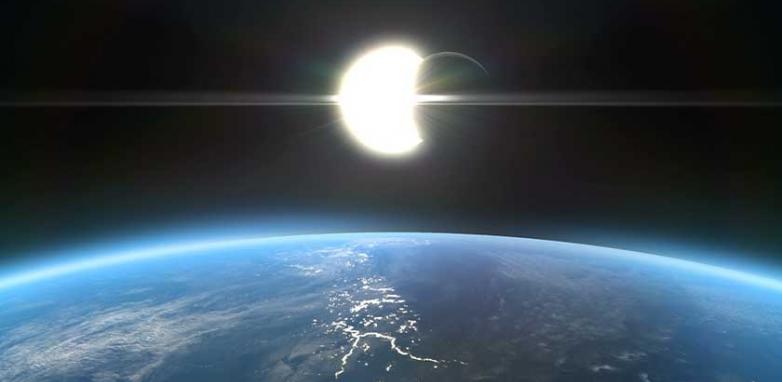
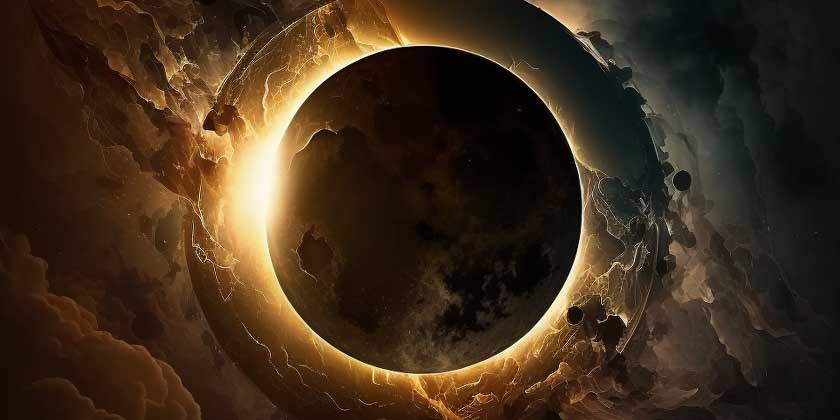
A solar eclipse takes place when the Moon positions itself between the Earth and the Sun, partially or totally blocking the sunlight that reaches our planet. This phenomenon can only happen during the New Moon, when the illuminated face of the Moon is turned towards the Sun and, consequently, is not visible from Earth, creating the ideal scenario for this type of occultation.
However, not every New Moon produces a solar eclipse. For a perfect alignment, the Moon and the Sun both need to be close to the lunar nodes. When this occurs, the Moon’s shadow is cast over the Earth and the eclipse is formed.
Types of solar eclipse
There are four main types of solar eclipse, and the difference lies in the relative position of the Moon and Earth as well as the distance between them:
 Total
Total
The Moon covers the entire solar disk. Day turns into night for a few minutes along a narrow path on Earth, called the “path of totality.”
 Partial
The Moon covers only part of the Sun, creating a “bite” of light in the sky.
 Annular
The Moon is farther from the Earth, so its apparent disk looks smaller. Even when it aligns with the Sun, it does not completely block the Sun’s light, resulting in a “ring of fire” visible in the sky.
 Hybrid
This is a rare eclipse that may appear as total in some locations and annular in others, depending on the curvature of the Earth and the path of the shadow.
When and where is a solar eclipse visible
Solar eclipses are only visible in specific parts of the Earth, in those regions crossed by the Moon’s shadow at the precise moment of the eclipse. For this reason, they are considered more exclusive and restricted astronomical events.
They are also brief events. The totality of a solar eclipse can last from a few seconds to about 7 minutes, depending on the conditions.
Historical and scientific curiosities
- Solar eclipses were seen as omens of disaster or shifts in power by many ancient cultures. Records show Chinese emperors feared these events, and some battles were interrupted as they were “swallowed by sky-darkness.”
- The famous May 29, 1919 solar eclipse was crucial in confirming Einstein’s theory of relativity, as scientists were able to observe the bending of starlight around the Sun, a milestone for modern science.
Solar eclipse and spirituality—new beginnings, revelations, and turning pages
The solar eclipse is associated with fresh starts, bold beginnings, and a redefinition of purpose. It is like a blank page that appears unexpectedly, often bringing revelations that change the course of our history.
This kind of eclipse can:
- Mark sudden turning points, such as endings, invitations, career changes, or relocations.
- Illuminate areas of life where things are stuck, bringing to the surface what must emerge for the new to have space.
- Indicate a period where conscious actions are firmly linked to long-term future goals.
To make the most of a solar eclipse's energy, avoid impulsive decisions. Embrace silence, listen to your intuition, and observe what life is revealing as a new start. Set intentions with awareness, even if only in your inner world.
Energetically, a solar eclipse calls for courage to break away from outdated patterns and to open yourself to the unknown, even if clarity comes only later.
Read the full article on Solar Eclipses to understand how this phenomenon ushers in beginnings and major turning points.
What is a lunar eclipse?

Definition and how a lunar eclipse happens
A lunar eclipse occurs when the Earth positions itself between the Sun and the Moon, casting its shadow over the lunar surface. For this to happen, the Moon must be in its full phase, with the alignment between all three celestial bodies happening near the lunar nodes.
Unlike solar eclipses, which occur during the day and are rarer to observe, a lunar eclipse can be seen at night by a large part of the world, as long as the sky is clear and the Moon is above the horizon.
Types of lunar eclipses
There are three main types of lunar eclipse:
 Total
Total
The Moon passes fully into the Earth’s shadow and may acquire a reddish shade, known as a "Blood Moon," due to the scattering of sunlight in the Earth’s atmosphere.
 Partial
Only part of the Moon enters the Earth’s shadow, creating a "sliced shadow" effect easily visible to the naked eye.
 Penumbral
The subtlest form of lunar eclipse, it happens when the Moon passes only through the Earth’s penumbra (the more diffuse part of the shadow). The darkening is light and is often imperceptible to casual observers.
When and where is a lunar eclipse visible
Lunar eclipses can be observed from anywhere on Earth where it is night at the time of the phenomenon. This makes them much more visually accessible than solar eclipses.
A lunar eclipse may last for several hours, from the beginning of the penumbral phase until the end of the full eclipse (when there is one).
Historical and scientific curiosities
- Ancient civilizations viewed lunar eclipses as warnings from the gods or moments of purification. In some indigenous cultures, it was believed that the Moon was being devoured by an animal or spirit, and that human sounds, such as chanting or drumming, would help free it.
- Unlike solar eclipses, lunar eclipses are completely safe to observe with the naked eye, and today, astronomers use them to study the Earth’s atmosphere and the surface of the Moon.
Lunar eclipse and spirituality—endings, hidden truths, and letting go
The lunar eclipse carries an energy of conclusion and revelation. It acts as a mirror, reflecting what was hidden beneath the surface, suppressed emotions, unspoken truths, the exhaustion of a cycle.
This is a time to:
- Let go of what no longer serves you, whether it be a relationship, a habit, an idea, or an identity.
- Face what has been swept under the rug, as the eclipse brings shadows to light, offering the possibility of healing.
- Feel deeply, since emotions rise powerfully, revealing what needs to be embraced before moving forward.
To make the most of a lunar eclipse’s energy, allow yourself to feel. Write, meditate, cry, rest. Let go of what is weighing you down, even if you’re not sure how. Small rituals of release, such as burning a letter or taking a cleansing herbal bath, can help seal this process.
Many people experience it as an intense emotional process, but also deeply transformative and liberating.
Read the full article on Lunar Eclipses and dive into themes of closure, revelations, and emotional release.
And what about eclipses in your birth chart?
Now that you understand what eclipses are and how they work, how about going deeper by looking at your own birth chart?
An eclipse never affects everyone in exactly the same way. It activates specific themes in your life, depending on where it occurs in the sky and which axis of your chart it touches, revealing areas that require attention, healing, closure, or new beginnings.
May each eclipse be an opportunity for both external and internal evolution!
Get your free Birth Chart on Astrolink
FAQ – Solar and Lunar Eclipse Questions
What are the 4 types of eclipses?
Eclipses are divided into four main types: total solar eclipse, partial solar eclipse, annular solar eclipse, and hybrid solar eclipse. For lunar eclipses, there are three variations: total, partial, and penumbral. This classification depends on the degree of alignment between the Sun, Earth, and Moon, and the position of the projected shadow.
Which solar eclipse is considered the rarest?
The hybrid solar eclipse is the rarest. It happens when, along its path, the same eclipse may be seen as total in some places and annular in others. This type of eclipse relies on a very specific combination of distance, Earth’s curvature, and the path of the lunar shadow.
Which eclipse made day turn into night?
The phenomenon of “day turning into night” happens during a total solar eclipse. In such cases, the solar disk is completely covered by the Moon, creating deep darkness for a few minutes, visible only along the so-called path of totality.
How many eclipses occur per year?
On average, 4 eclipses occur each year, including both solar and lunar eclipses. They happen during the so-called eclipse seasons, which repeat approximately every six months.
Is it true there will be eclipses in 2026?
Yes. Every year has at least two eclipse seasons. In 2026, there will be both solar and lunar eclipses distributed throughout the year, each activating different axes of the zodiac. Discover how the 2026 eclipses activate specific areas of your life by getting your free Birth Chart at Astrolink.
What is the difference between a solar and a lunar eclipse?
A solar eclipse occurs during the New Moon and is connected to new beginnings and external redirection. A lunar eclipse takes place during the Full Moon and symbolizes culminations, closure, and emotional revelations. Astronomically, the difference lies in which body casts the shadow: the Moon or the Earth.