The Saturn–Neptune Cycle and Advances in Medicine
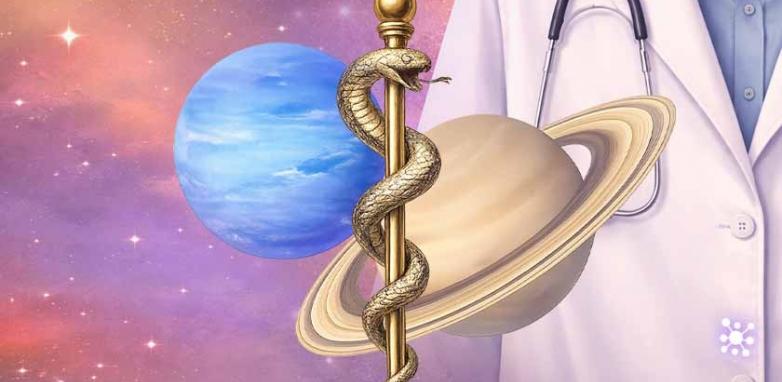
There are astrological cycles that do more than shift the emotional climate of an era, they reorganize the invisible structures that support the world. The conjunction between Saturn and Neptune is one of these rare milestones, and when it approaches, one theme tends to return forcefully to the center of history: medicine.
In previous cycles, this meeting coincided with moments when humanity redefined what it means by healing, prevention, and public health, from the consolidation of vaccines and anesthetics to revolutions in bacteriology, psychiatry, and genetics. That’s why, when looking toward the new cycle culminating in 2026, it makes sense to ask: what kind of structural advance is medicine preparing now?
Although the conjunction peaks in February 2026, its influence is not limited to that single day. A historical analysis shows that these cycles last between 36 and 37 years, but their effects begin to manifest up to five years before and continue to reverberate up to three years after the exact meeting at zero degrees. By considering this expanded window, it becomes possible to identify patterns that help us understand the present.
Historic Milestones of Medicine under Saturn, Neptune
In the cycle that began in 1809, hospital medicine gained power, abdominal surgery advanced, and there was a growing recognition of vaccines, along with the consolidation of practices that structured public and military medicine. The discovery of morphine and the treatment for Chagas disease were also key milestones of this period.
In the 1846 cycle, surgery was revolutionized by the introduction of general anesthesia, ether, and chloroform, as well as significant advances in obstetrics. Hospital hygiene and clinical examinations took crucial leaps, radically transforming medical practice.
In 1882, we lived through the golden age of bacteriology. Louis Pasteur deepened studies on microorganisms, vaccines became more established, and scientific psychiatry gained foundation, while Freud began his investigations into hysteria and hypnosis.
The 1917 cycle coincided with advances in war surgery and emergency medicine, with improvements in blood transfusion, orthopedics, fracture treatment, and radiology. Meanwhile, psychological studies expanded, including Jung’s publication of his “Red Book,” marking a decisive moment in understanding the human mind.
In 1952, we witnessed the foundation of the World Health Organization just before the first kidney transplant, the development of the defibrillator and artificial kidney, and the arrival of medications that redefined clinical practice, such as paracetamol and contraceptives. In Brazil, Nise de Silveira revolutionized the treatment of mental illness.
And in the cycle that began in 1989, advances in genetics, robotic surgery, cloning, and the creation of Brazil’s SUS (Unified Health System) signaled another structural reorganization in medicine and public health.
This is not about asserting direct causality, but about recognizing a recurring pattern, when Saturn, the symbol of structure and institutionalization, meets Neptune, associated with the invisible, the microscopic, with viruses and immune and psychological systems, medicine frequently enters periods of consolidation and breakthrough.
The Current Saturn, Neptune Cycle: 2026 and New Health Challenges
The world today faces complex public health challenges, even as it witnesses rapid advances in artificial intelligence applied to medicine, personalized therapies, biotechnology, and regenerative medicine.
It is within this context that the conjunction of February 20, 2026, occurs, when Saturn and Neptune align at zero degrees in Aries.
Saturn represents organization, responsibility, and materialization. Neptune symbolizes the invisible, subtle systems, immunological and psychological fields. When they align, we have historically observed not just breakthroughs, but a structural reorganization of medicine, where experimental discoveries gain real applications, new approaches become institutionalized, and health systems undergo profound reforms.
If the historical pattern repeats, this cycle may indeed coincide with another stage of structural reorganization in medicine.
A Brazilian Case: Research with Polylaminin
In Brazil, one of the most striking examples at this moment is the research on polylaminin led by scientist Tatiana Sampaio at UFRJ.
Early studies indicate the potential for neuronal regeneration and reconnection of damaged spinal cords. Preclinical results have shown significant motor recovery, and clinical trials in humans, scheduled during the upcoming cycle, have generated strong expectations within the scientific community.
If these results are confirmed with large-scale stability and reproducibility, their impact could represent a structural breakthrough in the recovery of patients with serious injuries previously considered irreversible. This is a field that, if it matures, could profoundly change how medicine addresses neurological damage.
The temporal coincidence between this advance and the beginning of the new Saturn, Neptune cycle does not imply determinism, but it symbolically echoes the historical pattern seen in prior conjunctions, moments when once-experimental discoveries began to consolidate at the institutional level.
The possibility of Brazil being at the forefront of such an innovation also recalls other periods when national medicine gained global prominence under similar cycles. Figures like Carlos Chagas and Nise de Silveira marked turning points by redefining clinical and institutional approaches. Over the decades, Brazilian researchers have also contributed to advances in pediatric cardiovascular surgery, the development of devices such as the stent, and research on microcephaly linked to the Zika virus, expanding the global reach of medicine developed in the country.
If fully confirmed, the current research could become part of this historical lineage of contributions that transcend boundaries, not as an isolated exception, but as part of a greater movement of structural reorganization in medicine.
Global Advances and the Medicine of the Invisible
The movement is not limited to Brazil. In parallel, Israeli researchers have developed artificial corneas using 3D printing, capable of producing up to 500 units from a single human cell sample in about two minutes. The technology employs biocompatible tissues with a low tendency for rejection and could revolutionize eye transplants. Currently, millions await corneal transplants due to a shortage of donors.
This type of breakthrough perfectly illustrates the symbolic meeting of Saturn and Neptune, the materialization (Saturn) of solutions for the invisible structures of the human body (Neptune).
Historically, the Saturn, Neptune conjunction brings together two complementary archetypes: structure and the invisible; consolidation and dissolution; institution and subtle field. At this point of convergence, we often witness profound reorganizations in the way humanity understands health, disease, and life itself.
A Cycle of Reorganization
This is not about predicting miracles or promising instant revolutions. But, in light of previous cycles, it’s safe to say we are entering a potentially significant period for medicine.
If current advances are consolidated, especially in areas like artificial intelligence, robotics, and neural regeneration, February 2026 could, in retrospect, be remembered as another milestone in a larger historical pattern.
Astrology, in this context, does not replace science; on the contrary, it offers a symbolic lens to observe the rhythms of history. And when Saturn and Neptune meet, medicine often rises to a new level.
Sign up at Astrolink to follow how these cycles may reflect not only on a global scale, but also in your personal life, with daily access to your horoscope and in-depth analyses.