Blue Moon, Supermoon, and Blood Moon: origins of the names
Terms such as Blue Moon, Supermoon, and Blood Moon are popular names used to describe different types of Full Moons. Although these names don't represent any permanent changes in the Moon, they originated from astronomical observations, cultural traditions, and humanity's need to organize time throughout history.
In this article you will learn about:
- What a Blue Moon is
- What a Supermoon is
- What a Blood Moon is
- Where these names came from
- Their astronomical and cultural meanings
Create your Free Birth Chart on Astrolink
Throughout history, the Moon has always been one of humanity's primary timekeepers. Long before formal calendars existed, ancient peoples observed its cycles to organize harvests, rituals, migrations, and survival activities.
Besides serving as a reference for time measurement, the Moon also inspired symbolic interpretations in many cultures, especially when uncommon phenomena were observed in the sky.
In some historical and religious contexts, eclipses were interpreted as omens. From an astronomical perspective, however, they are predictable and completely natural orbital alignments. It's worth reading our article on eclipses to understand much more about this phenomenon.
As civilizations advanced, we came to understand that lunar phenomena do not alter the Moon's physical nature. What changes is its orbital position, the way sunlight hits it, or how Earth's atmosphere interacts with this process. Still, many popular names arose around the world to label specific full Moons across different cultures.
Some of these terms have modern astronomical origins, while others are cultural inheritances from ancient traditions, often tied to agricultural cycles or seasonal calendars.
What Is a Blood Moon?
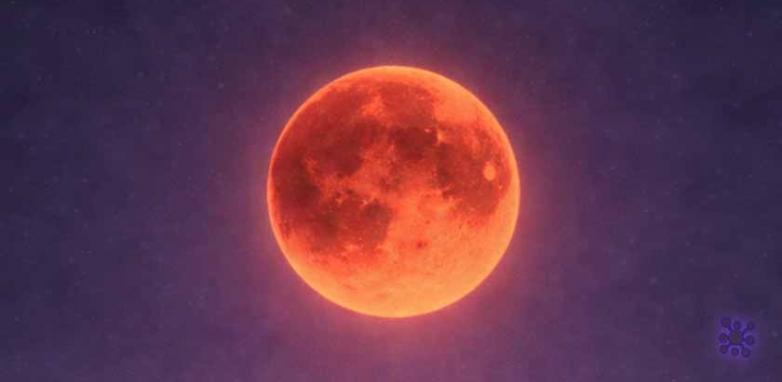
The term Blood Moon is primarily used to describe the Moon during a total lunar eclipse. In this phenomenon, the Earth positions itself directly between the Sun and the Moon, casting its shadow onto the lunar surface.
Even during a total lunar eclipse, the Moon does not completely lose sunlight. Part of the sunlight passes through Earth's atmosphere before reaching the Moon. During this passage, a physical phenomenon called Rayleigh scattering occurs, the same effect that makes the sky blue during the day and sunsets appear orange or red.
Atmospheric particles scatter shorter wavelengths (like blue and violet) more intensely. Meanwhile, longer wavelengths associated with red pass more efficiently through Earth's atmosphere and are redirected towards the Moon.
For this reason, during a total lunar eclipse, the Moon can take on hues ranging from copper and deep orange to intense red, giving rise to the name Blood Moon.
In other words, the name Blood Moon does not have a formal scientific origin, but is a popular term based on the visual appearance of the phenomenon since ancient times.
What Is a Supermoon?
The term Supermoon refers to when a Full Moon coincides with the perigee, the point in its lunar orbit when the Moon is closest to Earth.
The Moon's orbit isn't a perfect circle, but rather slightly elliptical. This means the distance between Earth and Moon varies throughout the month. When the Full Moon occurs near perigee, the Moon can appear up to about 14% larger and approximately 30% brighter compared to a Full Moon at apogee, its farthest point.
The term Supermoon did not arise in traditional astronomy circles. It was popularized in the 1970s and grew widely used by media and the public since then.
Despite the perception of increased size, the visual difference is usually subtle and often amplified by the so-called moon illusion, a psychological effect that makes the Moon seem larger when it is near the horizon.
What Is a Blue Moon?
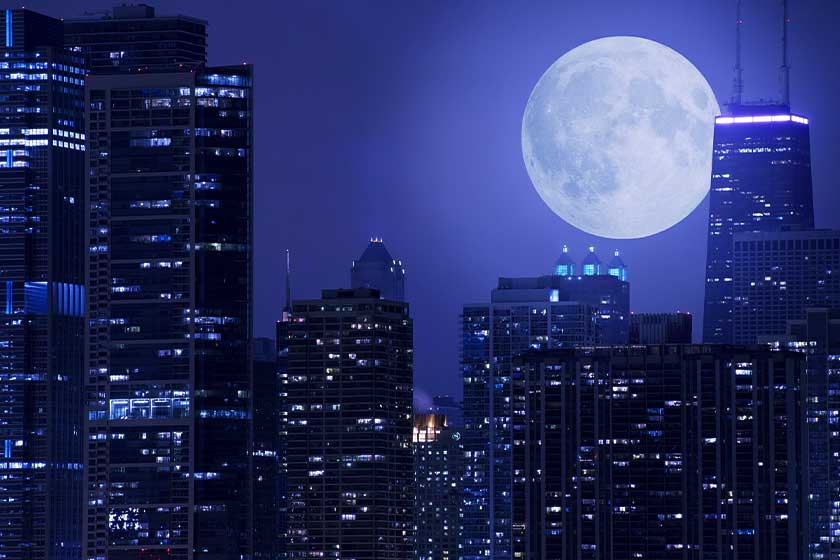
The expression Blue Moon has more than one historical meaning.
The oldest meaning refers to the third Full Moon within a season that has four Full Moons. Typically, each season has only three Full Moons. When a fourth occurs within the same season, one is called the Blue Moon.
This use appears in records related to agricultural calendars as well as the medieval liturgical calendar, which used lunar phases to calculate religious dates. Since a season normally holds three Full Moons, the occurrence of a fourth required a nomenclature adjustment to avoid confusion in setting movable feasts.
Some historical studies also suggest a curious linguistic origin for the term. In Old English, the word blue may have been linked to something like "betrayer" (belewe), implying a breaking of expectations. From this perspective, an "extra" Full Moon in a season was seen as the one that "broke the rule" of three. While this etymology is debated among historians, it appears in records and publications from the twentieth century, especially after a 1940s article in Sky & Telescope magazine helped popularize the term.
The most popular modern definition is the Blue Moon as the second Full Moon in a single calendar month. This meaning became widespread after a misinterpretation of an article published in the 1940s.
Since the average interval between two Full Moons is about 29.5 days, only months with 30 or 31 days can have a monthly Blue Moon, which explains its relative rarity. On average, the phenomenon occurs every two and a half years.
Despite the name, a Blue Moon does not actually turn blue. The term refers solely to the frequency of Full Moons, not their color.
The English phrase "Once in a blue moon" is widely known and used in quotes and the arts, especially in movies and music. It means something rare is happening, appropriately, since a Blue Moon is a relatively unusual event.
What Is a Harvest Moon?
The Harvest Moon is the Full Moon that occurs closest to the autumn equinox, regardless of hemisphere. The name originated among agricultural communities in Europe and North America, before the invention of artificial lighting.
During harvest time, farmers depended on natural light to work after sunset. Around this time of year, the interval between sunset and moonrise is shorter for several consecutive days, providing prolonged natural illumination in the early evening. This phenomenon favored agricultural work and led to the name Harvest Moon.
Observation of the agricultural cycles was one of the foundations that fueled the development of Astrology among ancient civilizations, even before its association with constellations. The Zodiac was born on Earth as an instrument for measuring earthly events in various phases, and only later was projected onto the heavens.
Other Traditional Full Moon Names
People across the world have named each Full Moon of the year to help organize the seasonal calendar. Many of these names were recorded by European colonists who documented Native American traditions.
Other historically documented examples include:
Wolf Moon (January) – Associated with the harsh winter in the northern hemisphere, when the howling of wolves was more frequently heard.
Snow Moon (February) – A reference to the month with the highest snow incidence in the northern hemisphere. Symbolically, in later interpretations, this period was associated with Aquarius, when melting occurred and water ran from the mountains into riverbeds, opening the way for Pisces season.
Pink Moon (April) – This name does not refer to the Moon’s color, but to the blooming of a wild pink flower typical of spring. "Pink Moon" gained popularity in the 1930s when a famous American almanac began sharing the traditional names given to Full Moons by indigenous North Americans. The Full Moon of April received this designation because of the flowering of a plant popularly known as creeping phlox, one of the first blooms to appear in northern hemisphere spring.
It’s important to note that these names make sense within the seasonal context of the northern hemisphere. In the southern hemisphere, April means autumn rather than spring, showing these names are localized, not universal.
Flower Moon and Buck Moon (May and July) – Related to the abundance of flowers in spring and the time when deer develop new antlers.
Corn Moon (September) – Linked to the harvest of corn, wheat, and other grains. Under the auspices of Virgo, this was the moment to thresh grain for later weighing and storage in Libra. In some Native American traditions, certain Full Moons have additional names connected to local wildlife, such as the Sturgeon Moon in August, associated with the period when this fish was easiest to catch in the Great Lakes of North America. These names show how Moon designations were deeply connected to the environment and the means of subsistence of communities.
The Moon as a Calendar Before Calendars
The names Blue Moon, Supermoon, and Blood Moon do not indicate physical changes in the Moon itself. They work as a kind of natural calendar, connecting the sky to human activities.
Before the standardization of the Gregorian calendar, the lunar cycle was one of the most reliable ways to measure time. Some lunar calendars even included a 13th month to adjust the lunar year to the solar year. A full lunation (from New Moon to New Moon) lasts about 29.5 days.
Civilizations such as the Sumerians, Babylonians, Egyptians, and indigenous peoples of the Americas developed calendar systems based on these cycles. In many cultures, each Full Moon marked an agricultural, climatic, or ritual event.
Over time, science separated symbolic interpretation from physical phenomena, but the traditional names endured as part of the cultural heritage of sky-watching. Regardless of the names, the Moon remains the same celestial body! It doesn’t grow, it doesn’t permanently change color, and it doesn’t acquire new physical properties. What does vary is:
- Its orbital position relative to Earth and the Sun;
- Orbital distance (perigee and apogee);
- Alignment during eclipses;
- Atmospheric conditions at the time;
- Human calendars.
These names reflect humanity’s ancient attempts to interpret and organize the sky, whether for practical reasons, cultural tradition, or modern popularization. Terms like Blood Moon, Blue Moon, or Supermoon demonstrate how science and culture walk hand in hand through the history of sky observation.
Astronomy explains these phenomena with mathematical and physical precision, while the popular names show how societies used the sky as a reference for survival, planting, harvesting, celebrations, and timekeeping, contributing to the first forms of astrological thinking and preserving traditions that have survived the test of time and reached us after millennia.
So when we refer to these various names for Full Moon phases, we’re dealing with nomenclature born from humanity’s need to organize time, adjust calendars, and interpret natural phenomena. Astronomy explains the mechanisms, while culture preserves the names, an amazing way to perpetuate traditions passed down through the generations.
Perhaps it’s exactly this coexistence of astronomical precision and cultural meaning that makes the Moon the most observed and named celestial body in history. Alongside the Sun, it remains one of the great luminaries for both science and astrology, crossing millennia without losing its power to mark time and inspire interpretations!
Frequently Asked Questions about Blue Moon, Supermoon, and Blood Moon
Does a Blue Moon actually turn blue?
No. The Blue Moon does not change color. The term refers only to an occasional extra Full Moon within a certain period, usually the second Full Moon in the same month.
Is the Supermoon really bigger?
Yes. During a Supermoon, the Full Moon occurs near its perigee and can appear up to about 14% larger and 30% brighter than a Full Moon at apogee.
Why does the Moon turn red during an eclipse?
During a total lunar eclipse, sunlight passes through Earth's atmosphere, and only the reddish wavelengths reach the Moon, creating the so-called Blood Moon.
What’s the difference between a Blue Moon and a Supermoon?
A Blue Moon is a calendar definition related to the frequency of Full Moons, while a Supermoon is an orbital phenomenon relating to the distance between Earth and the Moon.